
by Bryant Burroughs
No one lived there but the dead. And me, Balthamos the Tomb-Dweller.
The dead made no sounds. Their graves were silent. Even the wind whipping from the sea stilled itself and sneaked noiselessly through the tombs. The only sounds I heard were voices that screamed into my heart, never ending, always frightening, calling me terrifying names:
You Who Have No Soul.
The One who is Lost Forever.
We are Many and you are none.
I envied the solitude of the dead. They were beyond the hideous voices of the Many, who shriek murderously like a Roman legion charging across the battlefield.
Before I came to be the companion of the dead, there was a before, a time in which I was normal, a young man with a shy soul, a young man who preferred his own thoughts to the company of others. I had friends, but I trusted my inner voice and valued solitude above affection. A few women, strong-hearted and kind, tried to break through to my heart, but I withdrew more and more into myself.
It was then that the Many came. It began as a soft, calm voice, quieter than even my own inner voice, and nearly identical to it. I caught only a slight dissonance. If this new voice wasn’t my own, I pondered, then who could it be? Perhaps a new, more mature me?
I was mistaken. The new voice swelled and throbbed in my head with vicious attacks: “You’re not good enough. You’re a failure. No one cares for you.” Then, calamity of calamities, the one became many. I lost count of the number of not-quite-like-me voices that harried my every thought, my every day, my every second, cruel voices that somehow needed to torture my soul in order to live.
The torturers drove me away from my father’s house to this place of tombs and burial caves. They have named me “Tomb Dweller,” as they deride me day and night, shrieking with laughter.
It is impossible to escape this place and the Many. I’ve begged for help from passersby on the road that leads from my village, but my entreaties have terrified them. “Stay where you are, you babbler!” they shout, throwing stones at me. “Don’t bother us with your nonsense.” Time after time, I’ve retreated to the tombs, welcomed by the cackling of the Many.
This morning I’ve forged a desperate escape scheme. It must work, I hope to myself. Surely they will take pity on me. Holding a sharp stone in each hand, I craned my neck to watch for the dozen women who walk every sunrise to gather water at the village well. At last, their happy chattering drew near, blown by a promising breeze. With a sharp intake of breath, I slashed deep strips on my arms and legs. Fueled by pain and hope, I burst out of the tombs toward the women, screaming and waving my arms, begging for help, and threw myself at their feet.
Neither my blood nor pleas earned their kindness. Two women fled to alert husbands and fathers that the deranged Tomb-Dweller was threatening their women. The others kicked and beat me with their water buckets. “Get away from us, you crazy man!” they shouted. “Go back to the tombs where you belong!” As kicks and buckets pummeled me, my only thought was that even if these women killed me, death was preferable to life with the Many. But as I embraced my fate, pounding feet announced the arrival of husbands and fathers. They dragged me from the breathless women and hurled me back among the tombs. If the dead were watching, were they laughing or weeping that my escape try had achieved only a trail of my own blood? The dead remained silent.
Even the Many was silent. I wondered: Have they left me? Have they wearied of torturing me?
A kind voice snapped the silence. “Son? Are you there? Are you hurt?” Everything that is in me leapt in joy. I know that voice! Then – miracle of miracles! – my father embraced me, kissing my face and weeping over me. Even the Many must be afraid of a father’s love. That’s why they’re hiding in silence.
I clung to his neck as when I was a young boy. “Father, father,” I cried as I struggled to get to my feet, but he pushed down on my shoulders. He ran a hand over my face, as if he had a secret to tell that would be hard to bear. “Son,” he whispered. “I’m sorry.” I looked at him quizzically. “Father, it’s not your fault. I’ve brought myself to this lost place.”
Then he removed his hand from my face and raised it in the air, and I knew. I fought to stand up as three men dashed to us, bound me with ropes and chains, and secured the chains to a tree.
“Father, how could you?” I shouted as I writhed against the chains. “My own father!”
The Many spat curses at my father. “Do you think these chains can stop us, old man? You’ll see your son dead! You can’t beat us. He’s ours!” The men who had chained me fled in terror, but not my father. He leaned over and whispered in my ear. “Help is coming, my son. Run to him.” The he kissed my face and walked from the awful place of the dead, the curses of the Many drifting in the air like smoke.
After my father left, despair and hope rocked me like waves of the sea. At some point I slept, ending my day of torment. It was bright mid-morning when I awoke. As I began checking my cuts and bruises, I was startled to find the ropes and chains that had tightly restrained me now lay broken around me – not unlocked or cut but shattered as if a Samson had flexed his muscles and splintered them into small pieces. Is this the work of the Many? I wondered.
Murmurs of an approaching crowd interrupted my wondering. It couldn’t be the women, I thought. They’ve long been home from the well. It must be my captors again!
Crawling in panic to hide among the boulders, I froze as I glanced at the oncoming crowd. My father was walking in the lead, side-by-side with a man who was a stranger to me. Surely my father would not betray me a second time. How could he?
Then I looked closely at the other man, and shivered like a sail when it first catches the sea’s brisk wind. The Many went quiet, as if hoping to go unnoticed. In that unexpected silence, my own voice rang out: This must be the Help my father talked about. Run! As fast as my wounded legs would move, I sprinted toward the man who walked with my father. “Stop!” the Many howled. “He will hurt you. You’re not worth his time. You are a nothing.” But I ignored their warnings and threw myself at the man’s feet.
The man looked at me but spoke to my father. “Is this the son of many tears you told me about?” he asked, and my father nodded. The air was perfectly still. There was no sound from the crowd or the Many. It was as if sun and sky and tombs and people and the Many were all awaiting this man’s words.
I sensed that he was looking into me rather than at me. Then he spoke so quietly that I think only my father and I heard him: “Come out of this young man, you spirit. Stop torturing him.”
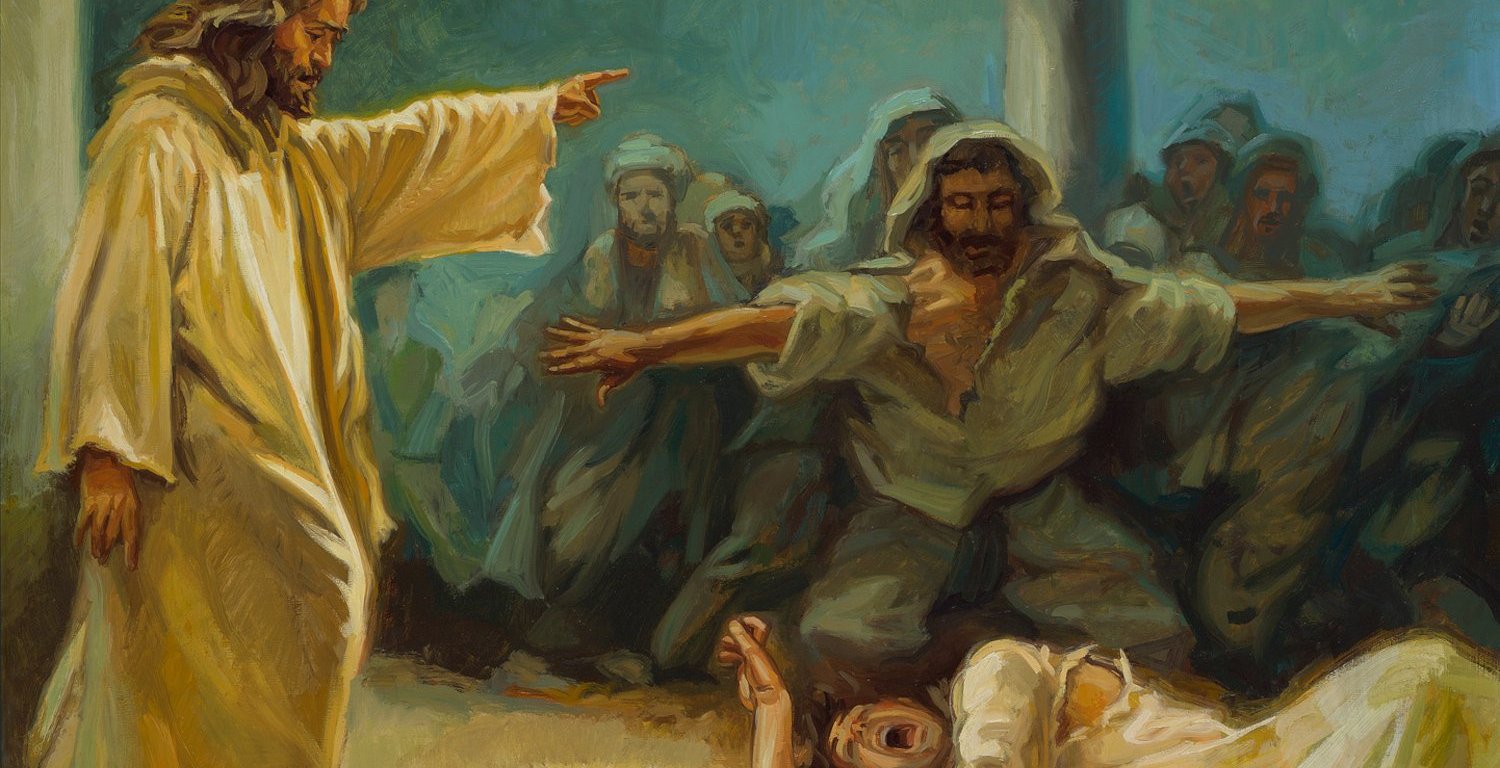
My mouth howled with my first occupier. “Why are you bothering with me, Jesus?” it screamed. “This runt is nothing. He’s not worth your time. Leave him to us.”
His eyes only on me, the man named Jesus asked, “What is your name?” I opened my mouth and the Many answered. “I am Legion!” it shrieked, “For we are Many!” I screamed my own name, but the sound was like a whisper in a windstorm. The Many roared with scornful laughter and sneered at Jesus, “See? He was empty. We filled him.”
Jesus sternly stopped their laughter. ”I tell you, come out now!” he ordered. His words wracked me as if a fierce windstorm were howling inside me, and I was blinded by a repeated flashing of light, as if dawn and night lasted only seconds. Buffeted by such furies, I lost consciousness.
I came to myself slowly, pulled – it seemed to me – by a universe of sound. A tumult of uncountable voices seemed to take up all reality. My soul vibrated with fear that the Many had returned, and that my liberation had been merely a wondrous dream. Yet, I realized, the immense sound was coming into my head, not within my head.
I awakened then and found my father washing my cuts and dressing me in clean clothes, unfazed by the tumultuous crowd surrounding us. A throng of people stretched as far as I could see. Most people were staring at me, while others peered down the road that led toward the sea. Some in the crowd were kneeling; others stood with upraised arms; still others covered their mouths in shock. Everyone was shouting.
Did you see what he did?
Is that the crazy man?
What happened to him?
Who’s going to pay me for my pigs?
Gripping my arm, my father tugged me to my feet. I stood unsteadily, exhausted and amazed.
“Sir, I owe you everything,” I said to the man who had banished the Many with a word. I looked at my father, who nodded as if he knew my next words.
I steadied myself and addressed my healer again: “To do this – to free me from the Many – you must be a prophet of God, about whom I’ve heard from my father. I beg you: let me walk with you and learn from you.”
He didn’t respond. Under his kind gaze, I felt scrutinized, as when a physician inspects to ensure that prescribed medicine has worked its healing miracle.
He must have been assured, for he answered after a moment. “Balthamos, your place is here with your father. These people around us are your neighbors and friends. If you wish to repay your debt, then tell them about the mercy God has shown you this day.”
Then he smiled and added, “I know they want to hear the Tomb-Dweller’s story.”
Bryant Burroughs is a writer and lives with his wife Ruth in Upstate South Carolina with their three cats. His work has appeared in online literary journals such as Foreshadow, Agape Review, Clayjar Review, Pure in Heart Stories and Faith, Hope & Fiction.
 Agape Review
Beautiful piece. I thoroughly enjoyed it!
LikeLike