
by Gillian Hutt
David turned in triumph from the stall in the crowded Jerusalem market. “I beat down the price,” he said, handing Miriam a cuff bracelet he’d been haggling over.
“It’s so pretty,” Miriam said, “with the silver filigree work, and these tiny red beads, they match my dress.”
“Let’s get a coffee,” David said. The market seller grinned and waved at them.
They walked in the warmth a short distance from the Arab to the Jewish quarter of the city, and found a café overlooking the paved square that led up to the Western Wall.
“You realise this is our first proper holiday together?” David said as the waiter brought their coffee. “I’m so enjoying it. Especially after my illness. I feel very lucky to have met you – late in life. Hope you’re having a good time!”
“It’s exciting,” Miriam said enthusiastically. “To be travelling again, and with you. Jerusalem is – amazing. I’d no idea that the sacred sites of the Jews, Muslims and Christians would be so close together.”
David said, “It’s peaceful now, but that’s fragile.” He indicated armed soldiers in black uniforms standing in the background.
He leant forward and took her hand. “Why don’t we stop living separately? You give up your home and come and live with me, or the other way round. Then we could be together all the time, wouldn’t that be great?”
Miriam gently withdrew her hand.
“Sorry.” She shook her head. “I don’t think I want that.”
There was a long pause. David turned his head away.
Miriam went behind him and put her arms round his neck, resting her cheek against his.
“I do love you, David,” she said. “Please let me explain.”
She hesitated as she sat down again. It was hard to put her thoughts into words. As a former English teacher, she fell back on a poet.
“Byron, the poet,” she said, “wrote, ‘Man’s love is of a man’s life a thing apart, ‘tis woman’s whole existence’.
That was so true when I was young! Then, we girls were always looking for true love. And when we’d found ‘the one’, we’d turn our backs on our families, careers, everything, if necessary, to be with him. Go to the other side of the world with him, without a second thought. Well, that’s what I did.”
She took a sip of coffee. “Men didn’t have to give up so much – they still had their careers.” She looked at him. “Is it different these days? I’m not sure! In the first whirlwind of love, isn’t it still usually the woman who compromises?“
David pushed back his chair and paid the bill.
“Come on, let’s go down to the square.”
Miriam took his arm as they went down the steps. “But at our stage of life,” she mused, “things have switched around? Maybe men want the whole commitment, and women want some independence?”
“You mean Byron no longer applies?”
“Exactly! He died at age 36, poor man, so he never found this out.”
Silence fell between them again. They watched the scene in front of them, as orthodox Jews wearing black gowns and black wide-brimmed hats over their plaited hair walked towards the wall, and reverently inserted paper messages into it.
Miriam was fascinated. “My great- grandmother was Jewish,” she said, “I was given her name. Now I’m interested in finding out more about her. What do you think they’ve written on those messages?”
“All the usual things people pray for, I expect.”
Miriam looked at him a little anxiously. “Do you understand what I’ve been saying?”
“Hmmm, not sure I agree though,” he said. But he was smiling.
Together, they walked away from the Western Wall.
Back in the busy Arab market, Miriam watched a black-clad woman crouched on the floor selling a colourful display of lemons and vegetables. Then she stopped at a stall heaped with leather bags. The leather looked soft and the designs attractive. When she glanced up, she couldn’t see David.
She scanned the crowd in vain. Taking her phone out of her bag, she realised she hadn’t charged it.
She stood for a moment in the bustling street, wondering what to do. She was struck once again by the way the people were working and mixing peacefully together, though she knew their homes were separated. She and David had been through the armed checkpoint to the West Bank and she had seen for herself where the Palestinian people lived. She thought of her former colleague whose father was Palestinian – had she grown up on the West Bank?
She set off slowly along the street. Had David stalked off in a huff? Certainly, they hadn’t been completely in tune, or he would have seen her stop at the leather stall. He’d evidently been hurt by what she’d said, or mis-understood her. Maybe he’d suffered too many rejections in the past. How much back story they both had! How much they still didn’t know about each other. It was complicated meeting someone in later life.
They both had families too, and that had been a challenge. Miriam’s three and David’s two had all been wary of the newcomer into their parents’ lives. Neither David nor Miriam had wanted to lose in any way the relationship they had with their own children. Miriam accepted the situation on the whole, though they were reluctant to meet David’s children. David’s daughter lived in Australia and he struggled to keep in touch with her. His son Matthew still lived close by, but he was troubled – aimless and prone to outbursts of anger.
Miriam pondered as she strolled past the stalls, puzzling how to put things right. Time, she felt, would be the answer to these difficulties. It would be gradual, they couldn’t rush it.
First of all, though, she needed to find David.
The market street ended, and she began to feel a little alarmed. Where was he? She cursed herself for not charging her phone. It was good being in a couple again, not having to concentrate so hard on checking keys, money, phone. But this was the downside.
She toyed with the idea of going back to their hotel and waiting for him there. But there were still places she wanted to see in the city, and they’d be leaving Jerusalem later.
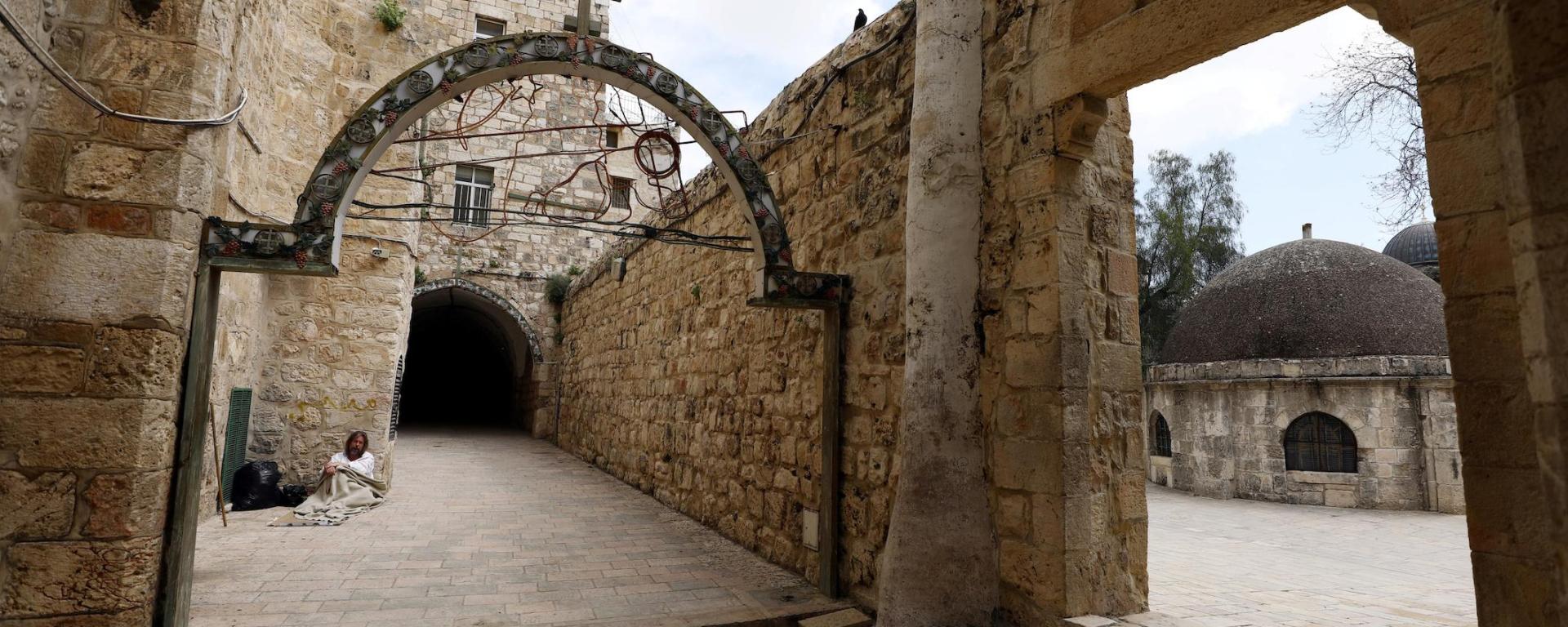
Then she remembered how David had talked earlier about visiting the Via Dolorosa, the route taken by Jesus on the day of his crucifixion. David had been to a Catholic school, the religious sites were important to him. Miriam decided to look for him there first. She asked a passerby in the crowd for directions.
David was tall and wore a red handkerchief round his neck. She spotted him with relief. He was standing, brow furrowed, by one of the many stalls at the foot of the famous path.
“What happened to you?” he said anxiously.
“I stopped in the market – and you’d gone. I forgot to charge my phone!”
He put his arm round her. “Thought I’d lost you. Don’t want that to happen.”
He bought her a glass of orange juice, and together they looked at the upward sloping track.
“There’ll be processions here soon, for Easter, but it’s quiet today.” David said. “At school, I heard so often about these holy sites. It’s wonderful to see them for myself.” He smiled at her, “Easter. the crucifixion and the resurrection, the most important time of year for Christians.”
“I know,” she said.
Miriam thought herself agnostic. But since she’d met David, sometimes she went to church with him. He’d wanted so much to visit the Holy Land. And she’d found on this holiday together how vividly she remembered the scripture teaching in her primary school. How interesting and even moving it had been to sail on a small boat on the lake that was called the Sea of Galilee, with the guide reading a passage from the Bible. Then later to be on top of the high mount and imagine Jesus standing there in a white robe, giving his sermon, holding in thrall a multitude of people below him.
David had stopped smiling and was looking downcast.
“I’m sorry we got separated,” Miriam said. “You feeling ok?”
David was gazing up the hill. He said, “I’m going to walk the length of this. You know, I feel this burden of guilt. It weighs on me, sometimes I find it hard to sleep.”
“What is it?”
“Why did I survive a serious illness when the others didn’t? I’m grateful, but so sad for others, for the ones who were on the same treatment as me but didn’t make it.” He sighed. “And what about you! We hadn’t been together all that long, had we, just beginning to have a good time together, and then you found you were looking after a sick man. Hardly fair on you. Again, I’m grateful, but sorry too, for landing you with all that.”
“The staff at the hospital did the looking after.” Miriam said. “I just did the visiting. Then when you came home again, helping you every day was no problem at all, it just came naturally to me.”
She sipped her juice. “For me, absolutely the most difficult thing,” she said hesitantly, trying to find the right words, “was dealing with your son, with Matthew. I haven’t been able to tell you till now. You know how before you were ill, he was often neglectful of you, and angry when he did see you. But when you got sick he became resentful and angry with me. Once I shouted back at him – I’m very ashamed of that. It was not my place, or my right to do that. I feel just awful about it.”
David nodded and touched her arm. “Matthew may be in his late twenties, but sometimes he behaves like he’s 14. That was the age he was when my marriage broke down – acrimoniously, as I’ve told you.”
“I do understand really – he was just a young teenager. So hard for him.” Miriam said. “But dealing with him, while I was so worried about you – that was upsetting.”
Slowly they set off together up the path, each bearing their burden of guilt. David’s head was down.
Miriam thought of the young man who, a thousand years ago, had struggled up this slope under the weight of a heavy wooden cross. So many years later, the uphill path still held an intense atmosphere. It felt like they’d gone back in time.
Her thoughts became filled with the passionate music and art that the crucifixion has inspired over hundreds of years. Almost she could hear in the background the sombre then glorious passages of Handel’s Messiah, of Bach’s St Matthew Passion, and in her mind’s eye she saw the thousands of frescoes and paintings of the scene, in art galleries and churches all across the world.
At the top of the hill, at the Church of the Holy Sepulchre, both David and Miriam felt awestruck and tearful, as if walking the sacred way had been not only unforgettable, but also transformative and life-changing.
Later that day, they were firmly back in the twenty- first century.
They’d moved on from Jerusalem and were bobbing about in the Dead Sea. From their low position, they looked out at the barren sand-coloured desert landscape above them. Except for a few palm trees at the edge of the blue water, the scene was bare of plants. Foothills led upwards, to a high plateau which bore the ancient fortification of Masada.
“I feel so much better – lighter,” David said, splashing water about. “Somehow renewed by taking that path, it’s lifted the weight of guilt.”
“I feel the same,” Miriam agreed. “It’s true. There was such a strong atmosphere there. Fervent – almost magical.”
David floated on his back. “I’ve been given this second chance at life,” he said. “I’m not going to waste it, or put off the things I want to do. Here we are at the lowest place on earth. Where shall we go next?”
“I’ve got a list in my head,” Miriam said laughing, as she tried to get her body to sink down into the water. She was not successful and she shot up again. A slight scratch on her arm was stinging from the intense saltiness.
After a while they waded out of the sea. As they showered away the heavy salt, Miriam remembered their difference of opinion earlier in the day. She felt the air had not been completely cleared.
With affection, she thought of her small home, how it had become a safe place for her, full of items that brought good memories, from before she’d met David. How bereft she had been after losing her husband. Slowly she’d learned to do things, then even to enjoy her independence.
Together, they walked up the hill towards their hotel.
Later they sat on the hotel terrace, sipping red wine from a Galilee vineyard, and tasting olives, hummus, pitta bread, pickles and hot sauce. The bare hills rolled out beneath them, leading down to the strange salty sea, silvery turquoise in the evening light.
David had obviously been thinking too about their earlier conversation. Relaxing, with his legs stretched out, he said, “You know, even when I was young, I was ready to fully commit myself to marriage. But it’s true I was also very dedicated to my job then. It took up a huge amount of my time.”
“I’m glad you understand what I was trying to say.”
“I’d still prefer to have you around all the hours, of every day. “
“Really?” Miriam laughed. “That might change!”
She dipped some bread in the hot sauce. “We live near each other, it’s the perfect compromise. Think how you can watch football for hours on TV with Matthew.”
“He’s certainly good company for that!”
“Great bonding opportunity. And I don’t have to pretend to be interested.”
David laughed and poured more wine. “OK then. We’ll do it your way. With regard to living arrangements, that is. Meanwhile, where shall we travel to next?”
Together they watched the red ball of the sun going down over the horizon. The evocative call of the Mullah echoed through the still air, summoning the faithful to prayer. In the background, from another direction, the chime of church bells could faintly be heard.
Miriam and David both smiled, mellow and content again, with the wine and the sunset and each other.
“I still have so much to find out about you, and you about me,” Miriam said, taking hold of his hand. “Also, we might change our minds. About how we live, apart or together, I mean. As time goes on.”
Gillian Hutt had an early writing success winning First Prize in a short story competition, judged by a well-known writer and broadcaster. More recently, she has had a number of short stories and poems published in The People’s Friend and in Woman’s Weekly magazines.
 Agape Review