
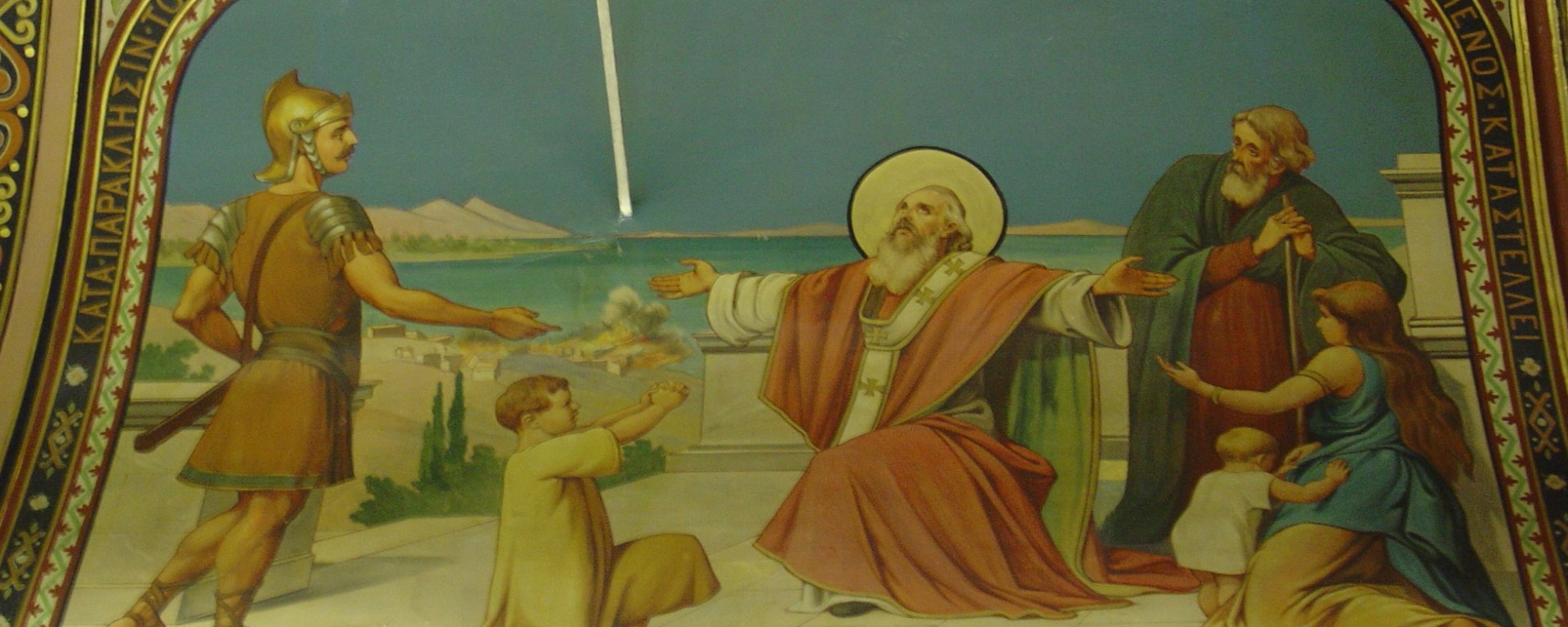
by Cynthia Gallaher
As every good tree produces good fruit,
Polycarp, the man,
bore a name meaning multiple fruits.

Beloved Bishop of Smyrna
in Asia Minor,
today’s city of Izmir, Turkey,

a settlement of Jews, pagans,
emperor-worshipers,
and Christians.

Christians persecuted for failing
to offer incense and worship
to Emperor Marcus Aurelius,

Considered god above god
in Rome, Olympus ultimately given
second-tier status to mere man,

An empire no longer SPQR,
no longer from the Senate or people of Rome,
now perhaps MRGA, for Marcus Aurelius,

Make Rome Great Again,
its ruler, a philosopher
and who may not even want to be a deity.

Yet Christian persecution
elevated in Smyrna,
parishioners urged Polycarp

To leave the city,
and hesitantly, he did so,
in line with the guidelines

of Matthew10:23,
“If they persecute you in one town,
flee to the next.”

In that next town,
Polycarp dreamt of his pillow
withering to ashes.

“I must be going
to be burnt alive,”
he told his protectors.

The local governor’s
soldiers finally tracked down Polycarp
after his servant was tortured

as to his master’s whereabouts,
in that a town after the last town,
where troops arrived at night.

Polycarp, asleep in the attic,
Awoke, arose and calmly went downstairs
to welcome the dispatch,

The soldiers astonished
they were there to capture
such an old, learned man,

Polycarp ordered servants to provide
the soldiers the food and drink
they wanted, while he went in private

to pray for everyone he had ever encountered,
great and lowly, known and unknown,
for the whole Church,

some soldiers,
embarrassed by his hospitality,
his brave and kindly demeanor,

still delivered him again to Smyrna,
to the circus, and its arena
of wild animals, gladiators,

chariot races, and Christian martyrs.
Polycarp stepped into the arena
in 155 A.D., amid an uproarious din,

a voice from heaven spoke only heard by a few,
“Be strong, Polycarp, play the man.”
The governor said,

“Take the oath and I will let you go,
swear ‘By the luck of Caesar,’
and ‘Down with the infidels.’”

He meaning, the Christians.
Yet Polycarp swept his hand
across the far bleachers of pagans

and mockers in the arena, saying,
“Down with infidels,”
but meaning all the others.

“86 years I have served him...
how can I blaspheme my God
and my Savior?”

The governor answered,
“I have wild beasts here.
Unless you change your mind,

I shall have you thrown to them.”
“Call them up,” said Polycarp,
“For it is out of the question

to exchange a good way of thinking
for a bad one. It would be a very creditable
thing, though, to change over from

the wrong to the right.”
The governor volleyed,
“If you do not recant,

I will have you burnt to death,
since you think so lightly
of wild beasts.”

Out in the arena now,
crowds again demanded
Polycarp be loosed to the lions.

But the day’s games had been officially closed,
so the woodpile and pyre
were indeed erected,

fulfilling Polycarp’s vision
of his pillow, catching fire and
and turning to ash.

Wood kindling and odd pieces were quickly
collected from the town workshops
and bathhouses.

Polycarp stood, unclothed,
barefoot, tied to the makeshift pyre,
praying long prayers

of thanks and praise,
and near his amen,
they lit the fire,

sheets of flames blazed,
the fire took on the shape
of an empty room,

Or a ship’s sail
filled with wind,
and in the center,

instead of a human figure,
the appearance of a loaf baking in an oven,
or an ingot of gold or silver

being refined in the furnace,
a fragrance filling
the air, like incense.

Polycarp’s body could not be destroyed,
so a hired daggerman finished him off,
much like the spearman had finished off

Jesus on the cross at Golgotha.
And here in the circus arena,
a dove flew out from among the burnt wreckage

as did so much of Polycarp’s blood,
to extinguish every flame.
Once his body was removed,

the crowd demanded
A later burning, public of his body,
leaving only his smoldering bones,

which his followers
gathered up and ushered away
as if they were jewels or fine gold.*
~ the relics of Polycarp now rest in Sant’ Ambrogio (Saint Ambrose) della Massima in Rome.
Cynthia Gallaher, a Chicago-based poet and visual artist, is author of four poetry collections, many with themes, including Epicurean Ecstasy: More Poems About Food, Drink, Herbs and Spices, and three chapbooks, including Drenched. Her nonfiction/memoir/creativity guide Frugal Poets’ Guide to Life: How to Live a Poetic Life, Even If You Aren’t a Poet won a National Indie Excellence Award.
 Agape Review